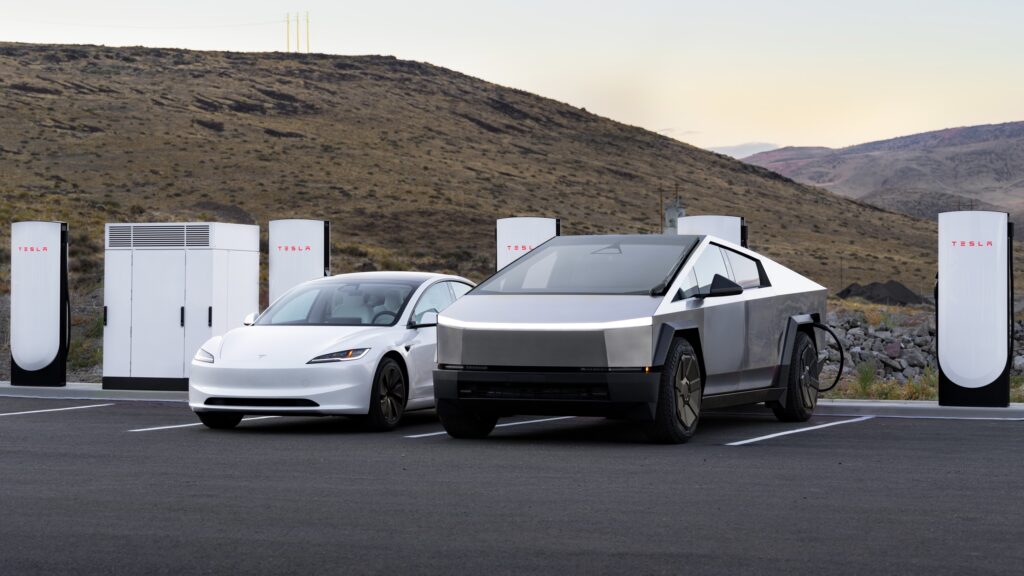
Tesla, Inc. — 2026 Awardee
Tesla continues to lead the way in state-of-the-art electric vehicle (EV) production and delivery, maintaining an annual pace of approximately 1,700,000 vehicles. From inception through mid-2026, Tesla has produced and sold millions of EVs worldwide, driving the historical foundation of the mass-market, tailpipe-emission-free passenger vehicle sector.
In 2025 alone, Tesla sustained this momentum by reporting 1,654,667 vehicles produced and 1,636,129 vehicles delivered globally. The company is also reliably expected to meet its long-term commitment toward net-zero carbon emissions, a trajectory bolstered by its mature positioning as a structural supplier of regulatory credits, which consistently generates substantial earnings from the sales of carbon offsets to legacy automakers. Since 2017, Tesla has accumulated over $10 billion (USD) from the sale of carbon offsets (officially called “automotive regulatory credits”) to legacy automakers.
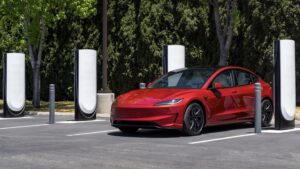
To support its vehicle fleet, Tesla has executed a massive global infrastructure rollout, expanding its proprietary Supercharger network to more than 3,000 active fast-charging locations in the United States alone. Globally, the footprint encompasses tens of thousands of active charging stalls. This public network operates primarily as a high-voltage, Direct Current (DC) fast-charging infrastructure. It is designed for rapid top-offs on high-traffic transit corridors and is increasingly open to non-Tesla vehicle brands via North American Charging Standard (NACS) integration.
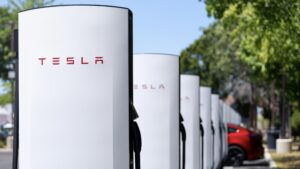
Although Tesla matches 100% of its global Supercharger network electricity consumption with renewable energy certificates (RECs), the physical charging stations must still draw the vast majority of their instantaneous power directly from the local public electric grid, occasionally buffered by on-site solar canopies and battery storage. Because regional grids are heavily fueled by a real-time mix of natural gas and coal, the physical electricity flowing directly into a plugged-in vehicle still carries a localized carbon footprint.
Tesla’s stated mission is to “accelerate the world’s transition to sustainable energy,” and the company actively works to “source and manufacture its products as sustainably as possible.” Still, The Vegan Digest asks that you please consider your personal stance on lithium industry and cobalt industry production practices at large.